
Article Summary:
The rapid evolution of industrial inkjet technology has led to single-pass and multi-pass printers becoming the central component of modern digital printing processes.
While both systems utilize advanced inkjet heads and digital control, their principles of operation, productivity, quality, and cost are significantly different.
According to the Inkjet Technology for Digital Manufacturing by Ian M. Hutchings and the Digital Printing of Textiles published by the Textile Institute, the architecture of the system, specifically regarding whether it employs single or multiple passes, directly affects the throughput, consistency, scalability, and practicality of the system for industrial use.
This article provides a comprehensive, industry-oriented comparison of single-pass and multi-pass printers. The article discusses the mechanical design, performance metrics, application scenarios, and the long-term return on investment of these devices.
Introduction: Why the Difference Between Single Pass and Multi Pass Printers Matters?
Today, digital printing has become much more popular than before. Today, industries that involve fabric printing, packaging, labels, corrugated sheets, decorative surfaces, and electronics all rely on high-speed inkjet systems to replace or supplement analog printing methods.
The fundamental alteration is based on the distinction between single-pass and multi-pass printers: single-pass printers versus multi-pass printers. Despite both utilizing inkjet technology, their logic regarding printing, productivity goals, and industrial applications is so different that selecting the wrong system can lead to inefficiencies, quality issues, or high costs.
Understanding the distinction is not solely technical; it’s also a strategic matter of business.
What Is a Single-Pass Printer?
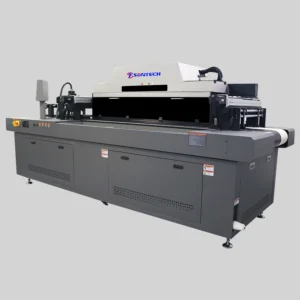
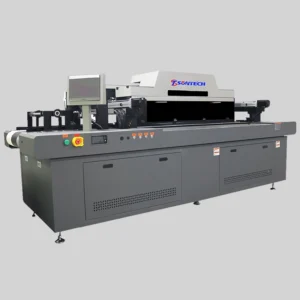
A طابعة أحادية التمرير is an inkjet printing system that has the print heads positioned in a stationary configuration across the entire width of the media. The substrate moves beneath the print bar continuously, and the entire process is repeated once.
-
The Essential Core Specifications of Single-Pass printers.
Constant print head array that covers the entire print area.
The media is moved once by the printers.
حجم إنتاج سريع للغاية
Perfect for manufacturing, and perfect for large volume printing.
Unlike tracking systems, a single-pass printer deposits all of the required ink in one motion; this motion is repeated over the same area multiple times.
-
Are the pros of single-pass printing considered paramount to the industry?
Single-pass printers are designed to be mass-produced in environments that require speed, consistency, repeatability, and automation. These systems are typically located in factories that operate during the day and have stringent requirements for output.
What Is a Multi-Pass Printer?
A multiple-pass printer employs a carriage that moves back and forth across the substrate. Every printed image is composed of multiple passes of ink, the first step of which is deposited in small quantities.
-
The Main Core Specifications of Multi-Pass Printer
Moving the print head.
Image constructed from multiple passes through the same place.
Lower startup cost
Adherent for short distances and frequent revisions
Many pass-through printers have a dominating presence in low and mid-range digital printing markets because of their versatility and lower technical difficulty.
Fundamental Mechanical Differences
The primary difference between single-pass and multi-pass printers is the mechanical design.
-
Printing Headstage configuration
In a single-pass machine, thousands of print points are organized in a full-width bar with a print. On the other hand, multi-pass printers have only a limited number of heads that travel across the medium in a lateral direction.
-
Motion Dynamics
Single Pass Printer: Media transport; the print heads are unable to move
Multiple Pass Printer: Heads move multiple times; media advances in small steps.
This distinction has a direct impact on speed, accuracy, and long-term wear.
Speed and Productivity Comparison
Productivity is often the primary cause of companies’ investments in single-pass printers.
-
Single Pass Produce Productivity
Single-pass printers have a maximum speed of around 50-100 meters per minute, depending on the resolution and type of ink. Because each image is printed in one motion, the output speed is still constant regardless of the complexity of the image.
-
Productivity on multiple passes with a multi-pass printer
Multiple-pass printers have a significant slowdown as the resolution and number of images increase. Every additional pass increases the time needed, which is not ideal for high-volume production.
Print Quality: Perception vs Reality
A common misconception is that multi-pass printers are always associated with superior quality prints. In reality, quality is determined by the accuracy of registration, the control of ink, and the calibration of the system.
-
Single Pass with a High Quality
Modern single-pass printers employ advanced colorimetric heads and accurate ink management. Once they’re properly tuned, they produce a highly consistent batch of quality across large production volumes.
-
Multiple Passes with Different Quality
Multiple pass printers have a high degree of quality on smallprints, but are more susceptible to banding, misregistration, and variation between passes, especially at higher speeds.
Comparison Table: Speed and Output Capability
| الميزة | طابعة تمرير واحد | Multi Pass Printer |
| طريقة الطباعة | One continuous pass | Multiple scanning passes |
| Maximum Speed | Very high | Low to medium |
| Output Consistency | Extremely stable | Varies with pass count |
| أفضل حالة استخدام | Mass production | Short to medium runs |
Cost Structure and Investment Considerations
- Initial investment
Single-pass printers have a higher initial cost because of the large number of print heads and the complex integration.
Multi-pass printers are more budget-friendly and accessible for mid-sized businesses.
- Operating expenses
While single-pass printers are costly to purchase, they often have a lower cost per volume because of their speed and efficiency in labor.
Comparison Table: Cost and ROI Factors
| Cost Factor | طابعة تمرير واحد | Multi Pass Printer |
| Initial Cost | Very high | Low to medium |
| Cost per Print (High Volume) | Low | High |
| Maintenance Complexity | High | Moderate |
| ROI Timeline | Long-term | Short-term |
Application Scenarios: Where Each Printer Excels
-
Single Pass Copiers
The most effective for large volume, industrial production.
Common uses
- Textile manufacturing (rolling fabric printing)
- Corrugated packaging and labelling
- Walls and panels of decoration
- Functional coatings and industrial printing.
Key attributes
- Extremely rapid printing
- Constant output over extended production periods.
- Perfect for manufacturing continuously, directly.
القيود
- Large-scale investment
- Less able to adapt to short periods of time or frequent design revisions.
-
Multiple Passprinters
Ideal for flexibility, customization, and smaller production quantities.
Common uses
- Sampling and prototypeing
- Customized clothing and promotional items
- Signs and decorations that are brief
- On-demand printing services
Key attributes
- Lower initial expense
- High-quality images via multiple passes.
- Wonderful for variable data and frequent revisions
القيود
- Lower frequency
- Less effective for large volume production.
Reliability and Maintenance Factors
-
Single Pass Authentication Schemes
Constant printhead arrays have to be precisely positioned.
Maintenance is more intricate but routine.
Downtime can be costly due to the production volume.
Supported by professional technicians and service agreements.
-
Multiple Passes Systems
Fewer printheads lower the cost of replacement.
Easy troubleshooting and maintenance on a daily basis.
More lenient in error tolerance
Adept at working in environments with limited professional expertise
Scalability and Automation
-
Single Pass Copiers
Extremely versatile in large industrial production lines.
seamlessly combined with:
- Automated feeding devices
- In-line drying and aging
- ERP and MEs frameworks
Perfect for operation around the clock.
-
Multiple Passprinters
Expand the fleet without increasing speed.
More practical to augment capacity by small steps
Less automation in the middle of the line than on the first pass.
More beneficial for patrons with evolving or ambiguous orders.
Environmental and Energy Considerations
-
Single Pass printing
Lower ink consumption because of the precise way it is deposited.
Reduced material disposal and re-work
High efficiency of energy per printed component
The larger absolute amount of energy consumed is due to the scale.
-
Multiple Pass printing
Increased ink consumption and energy expenditure per unit.
More passes lead to a greater increase in drying and curar demand.
Lower the overall footprint for low-volume operations.
More effective production models for specific, on-demand productions.
Decision Framework: Which Printer Should You Choose?
Use the following guidelines to assist you in your decision:
-
Select a single-pass printer if:
You manage a large-scale, daily production run.
Speed and consistency are of the utmost importance.
Designs have a long lifespan.
You have access to a technical support team and an automation platform.
-
Select a Multiple Pass Device if:
Your company specializes in customization and short sequences.
Product designs are frequently altered.
Capital expenditures must be able to adapt.
You care more about the flexibility of the system than the throughput it provides.
FAQ: Single Pass and Multi Pass Printers
Q1: What is the primary difference between single-pass and multi-pass printers?
The primary difference is in the architecture of printing: single-pass printers print one image in one consistent motion, while multi-pass printers create images by passing through multiple scans.
Q2: Is it always possible to skip the initial printing step?
Yes, in manufacturing environments, single-pass printers have a consistent advantage over multi-pass printers in speed and volume.
Q3: Do multiple-pass printers have a superior print quality?
Not necessarily. Modern single-pass printers have a high degree of consistency, which is especially true of larger productions.
Q4: Are single-pass printers appropriate for startups and small businesses?
Typically, no, because of the high initial cost and necessary infrastructure.
Q5: Whichprinter has a lower operating expense over time?
At higher production rates, single-pass printers have a lower cost per print.
Conclusion: Understanding the True Difference Between Single Pass and Multi Pass Printers
The distinction between single- and multi-pass printers is more extensive than simply speed. It has an effect on the production strategy, cost efficiency, scale, and quality consistency. While multi-pass printers still have a crucial role in terms of flexibility and customization, the Single Pass Printer has become the foundation of digital printing in industries. Consistency and automation have both been defined as successful.
For companies that want to increase their revenue and reduce costs, understanding the distinction is now an option-free choice—it’s crucial.
