
Article Abstract:
Direct-to-Film (DTF) and UV Direct-to-Film (UV DTF) printing technologies are increasingly being compared to one another as a result of customization, short-run production, and on-demand decoration that are part of the global printing industry.
According to Hitoshi Ujiie’s digital textile printing method and technical reports from FESPA and Smithers, conventional DTF printing involves the use of heat and textile compatibility, while UV DTF printing employs inks that are UV-curable and adhesive films that are non-porous in order to decorate surfaces that are not porous.
This article discusses the principles behind the structured, application-driven comparison of the DTF printer and the UV DTF printer. It explains the materials used, the performance differences between the devices, the cost structures of the devices, and their commercial potential, all of which were derived from information provided by leading industry resources.
Introduction: Why DTF and UV DTF Are Often Confused
As the demand for customization increases across apparel, promotional products, signs, and consumer goods, DTF printing technologies have become popular quickly. However, many consumers who are looking for a “DTF printer” now encounter a new term: the UV DTF printer. Despite the identical name, these two systems are not interchangeable, and misassumptions regarding the difference are often followed by expensive purchases that are mistakes.
In practice, DTF and UV DTF printers are intended for different substrates, processes, and models of business.
Understanding the distinction is crucial to print shops, distributors, and buyers of equipment who want to have profitable, scalable solutions instead of experimental installations.
What Is a DTF Printer?
A Stampante DTF (Direct-to-Film printer) is a digital printing system that is primarily utilized in the decoration of textiles. Instead of printing directly onto fabric, the printer produces graphics that are then transferred to a special PET substrate using water-based pigment inks. The printed image is then covered with a hot-melt adhesive powder and transferred onto fabric using a heat press.
DTF printing became a popular alternative to DTG (Direct-to-Garment) printing for fabrics with a darker color, materials that are mixed, and production that is small-batch.
How a DTF Printer Works (Step-by-Step)?
The DTF procedure is characterized by a standardized procedure:
Artworks are printed onto PET material using CMYK + white inks.
Hot-melt adhesive pellets are incorporated into the damp ink layer.
The movie is baked using a heating mechanism or oven.
The bonded transfer is heated and pressed onto fabric.
The movie is sliced, which leaves the ink attached to the fabric.
This procedure explains the reason for the association of DTF printers with textile compatibility and heat transfer.
Typical Applications of DTF Printers
DTF printers are typically employed in:
T-shirt and other apparel personalization
Sportswear and formalwear for teams
Cotton, polyester, and mixed fabric
Tote bags, hats, and other soft items
The distinguishing attribute is that DTF printing is most effective on materials that are porous, malleable, and can withstand heat and pressure.
What Is a UV DTF Printer?
A Stampante UV DTF utilizes ultraviolet printing technology along with a specialized surface transfer system that is designed to transfer ink to solid, non-porous surfaces without the need for heat. Instead of water-based Ink, ultraviolet (UV)-based printers utilize ultraviolet-curable Ink that immediately hardens under ultraviolet light.
Unlike the traditional method of ultraviolet printing, ultraviolet printing via direct transfer allows decals to be transferred instead of printed directly onto the intended target.
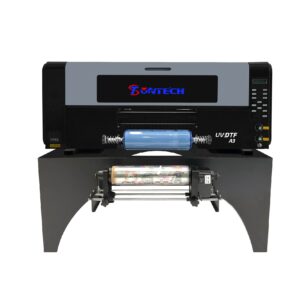
How a UV DTF Printer Works?
The ultraviolet (UV) DTF procedure is distinguished by its structural differences from the traditional method, DTF.
The ultraviolet ink is transferred to a release material (Film A).
UV lamps immediately mend the ink during printing.
A laminated adhesive sheet (Film B) is employed.
The entire combined decal is peeled away and applied to the intended surface.
Pressure promotes adhesion without temperature elevation.
This procedure eliminates the necessity of heat guns and increases the range of substrates that can be compatible with expansion.
- The difference between DTF and UV DTF printers is the core of the issue.
The primary difference is in their purpose, which is decorating.
DTF printers are designed to be compatible with textiles and transfer based on heat, while UV DTF printers are specifically engineered to be compatible with hard, smooth, and irregular surfaces, where heat is not practical or damaging.
DTF Printer vs UV DTF Printer: Technical Comparison
| Aspect | Stampante DTF | Stampante UV DTF |
| Tipo di inchiostro | Water-based pigment ink | UV-curable ink |
| Transfer Method | Heat press | Cold pressure |
| Primary Substrates | Fabrics | Hard & non-porous materials |
| Curing Process | Thermal curing | UV light curing |
| Surface Flexibility | High | Low to moderate |
| Equipment Cost | Lower | Higher |
| Learning Curve | Moderate | Higher |
| Production Speed | Medium | High |
- Material Compatibility Differences
The compatibility of material is the most important factor in the decision between a DTF printer and a UV-based DTF printer.
The DTF Printer’saterial’s scope of work
The DTF printers have a specialty in providing:
Cotton
Polyester
fabric combinations
Canvas
Fuzzy promotional products
Rigid surfaces typically have a poor performance because the ink layer is intended to conform to the fabric’s fibers.
UV Printer’saterial scope
UV DTF printers are effective with:
Glass
Metal
Plastic
Acrylic
Ceramic
Wood (with or without a coating)
This is beneficial to the UV DTF in that it can be used to create signs, custom packaging, and promotional products.
- Robustness and Performance Abilities
DTF prints are designed to withstand washing and flexibility; they do not have an abrasive surface to abrasion. Conversely, UV DTF prints have a superior surface affinity, scratch resistance, and chemical stability following the cure.
This discrepancy is responsible for the popularity of UV DTF printing in commercial and decorative environments instead of apparel.
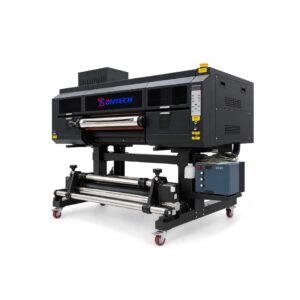
Production Workflow and Efficiency
- DTF Production Workflow
Print on PET material
Use the adhesive method
Heat treatment
Heat transfer by press
Remove and complete
This process is both flexible and involves multiple manual steps, which will affect consistency across the entire scale.
- The production of UVDTF follows these steps:
Print ultraviolet ink on glass
Instantaneous UV exposure
Laminate the adhesive in a solid layer
Apply to the substrate with pressure.
UV DTF processes are more automated and reproducible; they provide greater consistency in the branding of products and the utilization of industrial devices.
Cost Structure Comparison
- The cost of the DTF Printer is described in this manner
Lower initial cost of equipment
Consumables include ink, movie, powder, and energy for heating.
Intensive labor processing (powdering and curing)
Lower costs associated with material print volume at a larger scale.
- UV Printer Cost Profile
Increased investment in the front
Higher costs of ink and film.
Lowered steps of manual labor due to the inline process of curing and lamination.
Increased sales volume per unit of finished products.
DTF prefers efficiency in cost at volume, while UV DTF advocates for higher-priced products with smaller batch sizes.
Market Trends and Adoption
- The DTF Printer Market
Immediately following the introduction of Computer-Aided Design in the mid-sized fashion industry, there has been a rapid adoption.
Extremely strong growth derived from customization, on-demand production, and low cost of setup.
Increasing the popularity of digital printing for limited quantities.
- UV Printer Market
The increasing popularity of personalized products in consumer goods.
Adequate adoption in promotional products, signs, and services.
Popular with companies that want to expand past the flatbed ultraviolet printing method.
Overall, DTF is more popular in volume-based markets for textiles, while UV DTF is more popular in high-value-added markets for customization.
Choosing Between a DTF Printer and a UV DTF Printer
The choice should be based on the substrate’s type and intended final use.
Select a DTF Printer if:
Your primary interest is in apparel or fabric-based products.
You must have a soft touch and stretchiness.
You cater to fashion, promotional clothing, or athletic wear markets.
Select a UV Printer if:
You produce prints on flat or uneven surfaces.
You need a strong bond without temperature elevation.
You want to personalize the products for consumers, signs, or industrial design?
In general: DTF = fabric; UV DTF = solid surfaces.
Common Misconceptions Clarified
Misconception 1: UV DTF is only “DTF with ultraviolet ink”.
This is false. While both utilize transfer films, their chemical composition, methods of curing, and results of application are markedly different.
DTF employs water-based pigment ink and a heat transfer mechanism.
UV DTF is a method of manufacturing that employs ultraviolet-curable ink and pressure-based lamination.
They are intended for different substances and purposes.
Misconception 2: UV DTF Can Be Substituted for Traditional DTF in Fashion.
UV DTF is not appropriate for printing fabric. The ink that is cured by the ultraviolet light is solid and lacks the stretchiness necessary for fabric. DTF is still the most popular solution for clothing.
Misconception 3: UV DTF is consistently more profitable.
While UV DTF is capable of higher yields, it also necessitates higher costs for equipment, material, and processing. The profitability of a business is dependent on the product variety and marketing strategy, not just the technology itself.
FAQ: DTF Printer vs UV DTF Printer
Q1: Is a ultraviolet (UV) DTF printer more effective than a DTF printer?
Neither is consistently superior. Each is designed for a different type of material and application.
Q2: Can ultraviolet (UV)-based printers print on fabric?
UV DTF printers are not well-suited for fabric printing because of their ink’s rigidity and lack of fabric interaction.
Q3: Do DTF printers have to use heat to print?
Yes. Heat transfer is crucial to the successful adhesion in DTF printing.
Q4: Does the UV printing method have a long lifespan?
Yes. Inks that are UV-cured have a strong resistance to ultraviolet exposure and abrasion.
Q5: Whichprinter is more appropriate for novices?
DTF printers are typically simpler to learn and maintain for beginners who are new to the field.
Conclusion: Understanding the Difference for Smarter Investment
The distinction between a DTF printer and a UV DTF printer is not gradual: it is structural. DTF printing is based on textiles, heat transfer, and flexibility, while UV DTF printing is concerned with solid surfaces, cold application, and long durability.
For companies that want to print sustainably, understanding the distinction will lead to a better selection of equipment, a more direct service position, and a higher long-term profitability. Instead of evaluating which technology is superior, the more strategic question is which technology is in line with your materials, customers, and growth strategy.