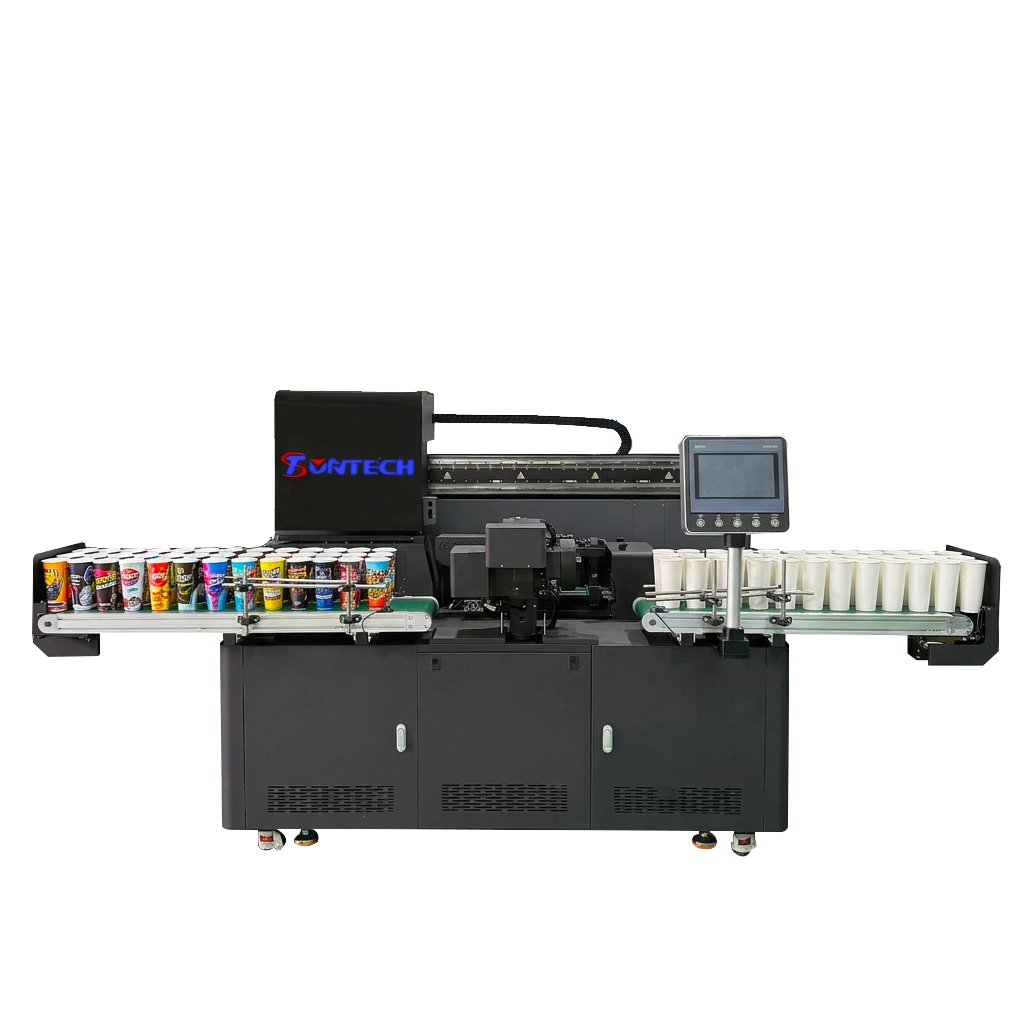
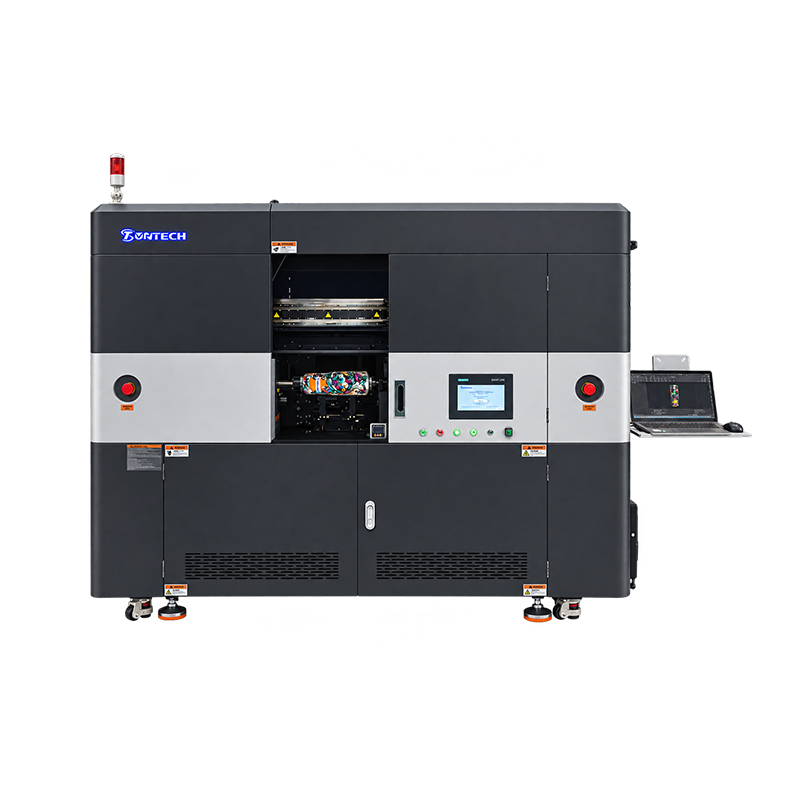

UV DTF is not necessarily better than standard DTF in all situations; the most suitable option depends on the substrate, product type, and intended application. UV DTF printers use UV-curable inks and adhesive transfer films to decorate hard, non-porous surfaces, such as glass, acrylic, metal, and ceramics. By contrast, a conventional Imprimante DTF uses water-based pigment inks, hot-melt adhesive powder, and heat pressing to transfer designs onto textiles. As explained in FESPA’s technical overview of direct-to-film printing and industry equipment guides, these two technologies serve different production needs rather than competing for the same applications.
When evaluating printing equipment, businesses should consider not only which technology produces better prints, but also which system offers the right combination of substrate compatibility, production efficiency, durability, customisation flexibility, and operating cost. Understanding these differences helps printing companies, promotional product suppliers, and customisation businesses to invest in equipment that matches their actual customer demand.
What Is DTF Printing?
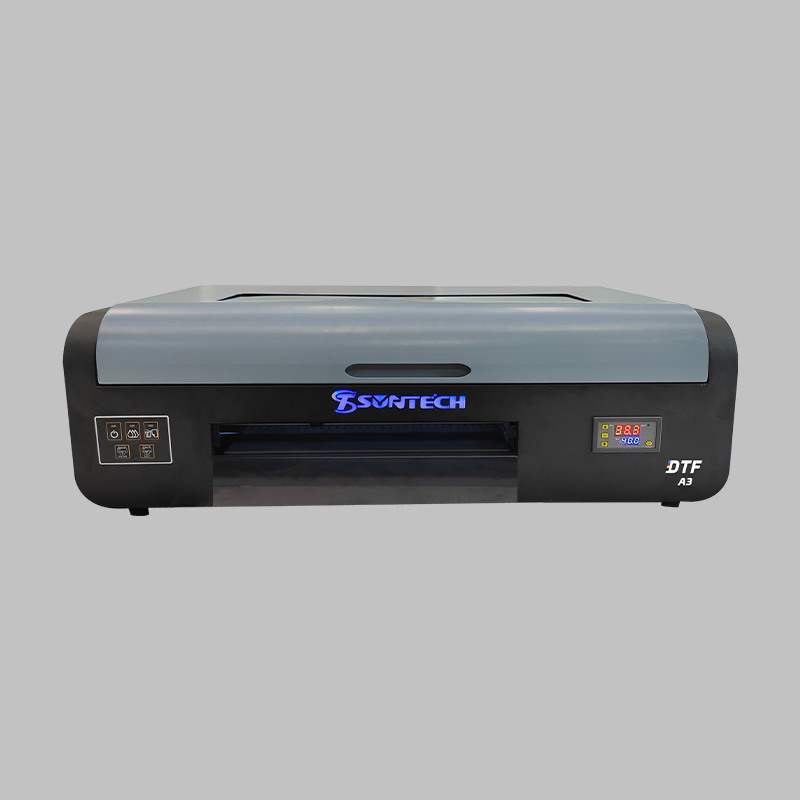
DTF (Direct-to-Film) printing is a textile decoration technology that transfers digital designs onto fabrics via a printed film, rather than printing directly onto the garment. Popular in apparel customisation, it supports colourful graphics and fine details, and can be used for small production runs without requiring a separate screen for every design.
The standard DTF process involves printing CMYK and white pigment inks onto a specialised PET film, applying hot-melt adhesive powder to the wet ink, curing the powder, and then transferring the design to the fabric using a heat press. Once the film is peeled away, the printed design remains bonded to the textile.
According to FESPA’s explanation of the technology, white ink is important for producing vivid colours on dark garments, and the adhesive powder and heat transfer process enable the design to bond with the fabric.
How a DTF Printer Works
- Artwork preparation: Create the design in compatible graphics software and prepare the color and white-ink layers using RIP software.
- Film printing: Print the design onto PET transfer film, typically with a white underbase for dark or colored fabrics.
- Adhesive application: Apply hot-melt adhesive powder to the printed surface and remove excess powder.
- Adhesive curing: Heat the powder according to the ink and adhesive manufacturer’s specifications to form a consistent bonding layer.
- Heat transfer: Position the transfer on the garment and apply controlled temperature, pressure, and time using a heat press.
- Film removal and finishing: Peel the carrier film according to its release characteristics and complete any recommended finishing press.
DTF is particularly suitable for T-shirts, hoodies, sportswear, uniforms, tote bags, and other textile products. Its main advantage is that the transferred design can accommodate the movement and flexibility of fabric when the appropriate ink, adhesive, and application parameters are used.
What Is UV DTF Printing?
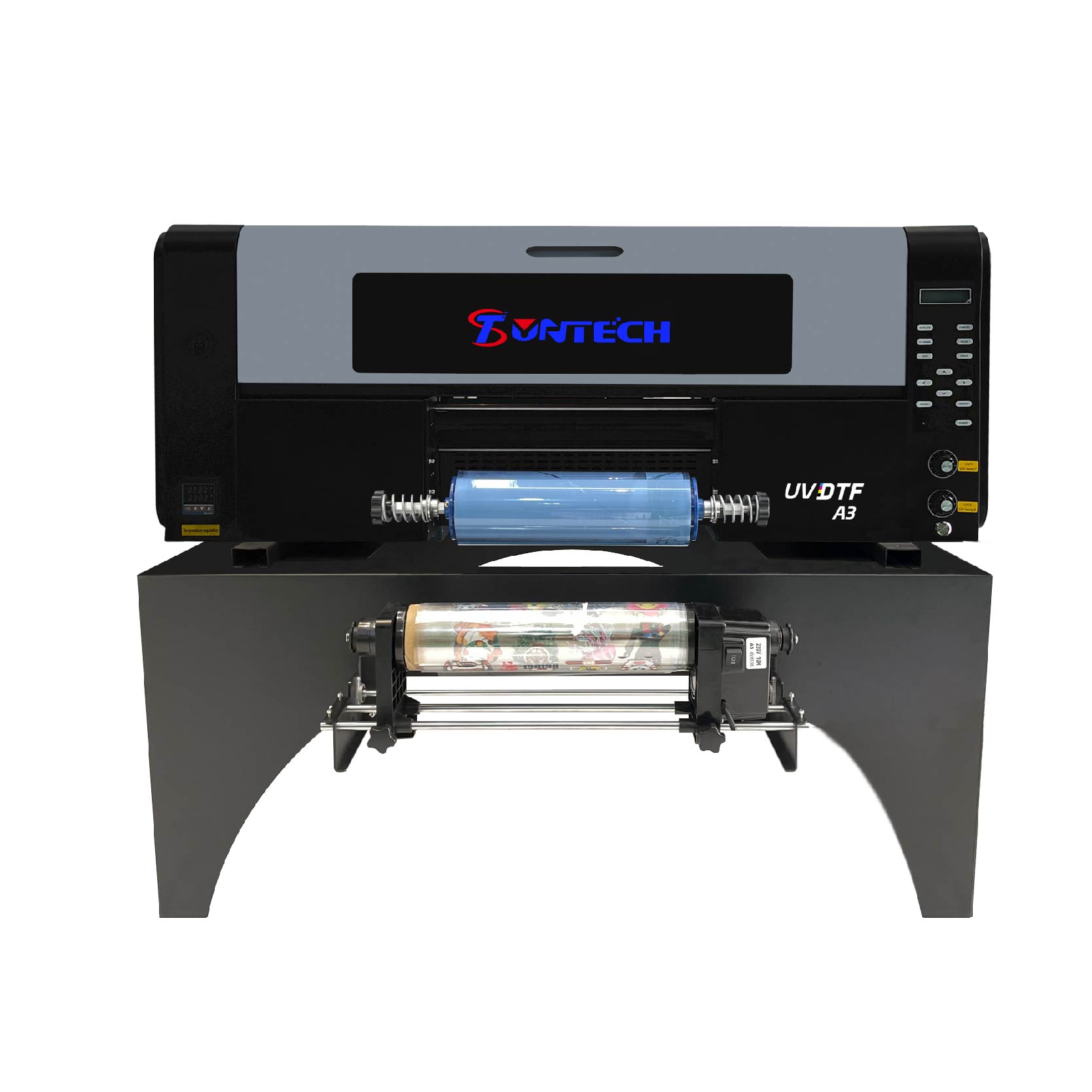
UV DTF stands for ultraviolet direct-to-film printing. Using UV-curable inks that solidify under ultraviolet LED light, it creates decorative transfers for compatible hard surfaces with a specialised adhesive film system.
Unlike traditional DTF printing, UV DTF printing generally does not require hot-melt adhesive powder, a powder curing oven, or a garment heat press during application. Instead, the design is first printed onto a film, then cured using UV light and laminated with a transfer film. The finished graphic can then be applied to a suitable object under pressure.
How does a UV DTF Printer Work?
- Design preparation: Create artwork with appropriate color, white-ink, and optional varnish layers.
- UV printing: Print the design onto the specialized A film using UV-curable inks.
- UV curing: UV LED lamps cure the ink as it is deposited, producing a stable printed graphic.
- Film lamination: Apply the B film to the printed design to form a transferable decal.
- Transfer application: Position the design on a clean, compatible surface and press firmly to establish adhesion.
- Carrier removal: Peel away the transfer film as instructed, leaving the printed design on the product.
UV DTF is commonly used for glassware, tumblers, acrylic signs, metal promotional products, ceramic items, phone cases, and other rigid merchandise. Its ability to decorate objects that are difficult to feed through a conventional flatbed printer makes it especially valuable for product personalization.
UV DTF vs. DTF: Key Differences
Although the names are similar, these technologies differ in ink chemistry, consumables, transfer mechanisms, and compatible substrates. Understanding these differences is essential when comparing a UV DTF printer with a conventional DTF printer.
| Comparison Factor | Imprimante DTF | Imprimante UV DTF |
| Full name | Direct-to-Film | Ultraviolet Direct-to-Film |
| Type d'encre | Water-based pigment ink | UV-curable ink |
| Printing medium | PET transfer film | Specialized UV DTF A film |
| Adhesive system | Hot-melt adhesive powder | Pressure-sensitive adhesive film |
| Méthode de séchage | Heat cures adhesive powder | UV LED cures ink |
| Transfer method | Heat press | Manual pressure application |
| Primary substrates | Cotton, polyester, blends, textiles | Glass, acrylic, metal, ceramic, rigid plastic |
| Additional equipment | Powder applicator, curing oven, heat press | Film laminator or integrated lamination system |
| Print characteristics | Flexible, textile-compatible finish | Glossy or textured, relatively rigid finish |
| Typical products | T-shirts, hoodies, bags, uniforms | Tumblers, bottles, phone cases, signs |
| Main production advantage | Efficient garment decoration | Versatile hard-surface personalization |
| Main limitation | Not designed for most rigid non-porous goods | Not designed for ordinary flexible garments |
Ink and Material Compatibility
One of the most important distinctions between the two systems is the ink formulation. Standard DTF inks are designed for textile transfers and work with a compatible hot-melt adhesive to bond with the fibres of the fabric. In contrast, UV DTF inks contain photopolymer components that cure under ultraviolet light, producing a relatively firm decorative layer.
This difference is why the two technologies cannot simply share consumables. Using the wrong ink, film, adhesive, or curing conditions can result in poor adhesion, inconsistent transfer quality, or premature product failure. Manufacturers of equipment such as INKA Print Systems specifically emphasise that textile DTF and UV DTF require their own compatible inks, films, and application workflows.
Application and Production Workflow
Standard DTF requires several connected production stages, including film printing, powder application, adhesive curing, and heat pressing. For businesses producing apparel at scale, these steps can be organized into an efficient workflow with automated powdering and curing equipment.
UV DTF has a different production structure. Once the transfer is printed and laminated, it can be applied to the target object without a conventional garment heat press. This reduces the number of steps involved in customizing certain products and makes it easier to decorate objects with handles, unusual shapes, or surfaces that are unsuitable for direct printing.
Which Printing Technology Produces Better Results?
The answer depends on how print quality is defined. Color vibrancy, detail, adhesion, flexibility, surface finish, and resistance to environmental exposure all matter, but their importance changes depending on the finished product.
Color Vibrancy and Image Detail
Both technologies can reproduce complex graphics, fine text, gradients, and multicolour designs when supported by the appropriate RIP software and printhead configurations. White ink is particularly important when printing on dark or transparent substrates, as it provides an underbase that keeps colours visible.
DTF is ideal for detailed apparel graphics as the transfer process can reproduce artwork without the garment needing to pass through a specialised digital printer. UV DTF can produce visually striking graphics on hard goods, especially when white ink and varnish are used to create contrast, gloss or decorative effects.
However, print resolution alone does not determine the quality of the final product. The substrate, film, ink formulation, curing conditions, and transfer technique all influence the final appearance.
Durability and Resistance
DTF durability should be evaluated in terms of washing, stretching, and repeated garment use. A properly produced transfer can withstand repeated laundering, but actual performance depends on adhesive quality, fabric composition, curing, pressing parameters, and care instructions.
UV DTF durability is evaluated differently. For rigid products, relevant factors include adhesion, abrasion, moisture exposure, cleaning chemicals, and outdoor UV exposure. A transfer that performs well on a glass tumbler may not perform equally well on untreated plastic or a textured surface.
Manufacturers’ technical documentation also cautions that UV DTF adhesion varies with surface preparation and the specific film system. For example, Xpres recommends cleaning application surfaces and following product-specific care and curing instructions.
Neither technology should be considered universally more durable. Each is engineered for a different physical environment.
Applications: Where Does Each Printer Perform Best?
Applications de l'imprimante DTF
DTF printers are primarily used in textile customization and apparel manufacturing. Typical applications include:
- Fashion and apparel: Custom T-shirts, hoodies, sweatshirts, and personalized clothing.
- Sportswear: Team uniforms, jerseys, training apparel, and performance garments.
- Promotional textiles: Tote bags, event merchandise, corporate gifts, and branded fabric accessories.
- Small-batch customization: On-demand apparel, personalized gifts, and short-run fashion collections.
- Print-on-demand businesses: Designs can be prepared as transfers in advance and applied when orders arrive.
The technology is especially attractive for businesses that handle diverse designs and variable order quantities. Because the artwork is digitally produced, changing designs does not require preparing a new physical screen for every job.
UV DTF Printer Applications
UV DTF printers serve product customization businesses that work primarily with hard goods and decorative merchandise. Typical applications include:
- Drinkware: Tumblers, mugs, bottles, and reusable cups.
- Promotional products: Corporate gifts, branded merchandise, and event giveaways.
- Personal accessories: Phone cases, decorative items, and selected accessories.
- Signage and displays: Acrylic plaques, product labels, and small decorative signs.
- Industrial and retail products: Product identification graphics and branding for compatible surfaces.
UV DTF can be especially useful when a product cannot be easily positioned under a conventional UV flatbed printer. The transfer film allows a printed design to be applied separately, expanding the range of shapes and objects that can be customized.
Cost, Productivity, and Business Profitability
When comparing a UV DTF printer with a DTF printer, the initial equipment price is just one aspect of the overall investment required. Businesses should also consider consumable costs, labour, maintenance, production volume, finishing equipment, and the average selling price of customised products.
A conventional DTF workflow may require a printer, RIP software, PET film, textile inks, adhesive powder, a curing system, and a heat press. In contrast, a UV DTF setup requires UV inks, A/B films, and compatible printing and lamination equipment. The exact investment required depends on factors such as print width, automation, printhead configuration, and production capacity.
Cost and Operational Comparison
| Cost or Business Factor | Imprimante DTF | Imprimante UV DTF |
| Equipment investment | Printer, powder system, curing equipment, heat press | Printer, UV curing system, film laminator |
| Consumables | Textile ink, PET film, hot-melt powder | UV ink, A film, B film |
| Labor requirements | Multiple processing and pressing stages | Printing, lamination, trimming, and application |
| Best production model | Apparel orders and textile transfers | Personalized hard goods and decorative transfers |
| Order flexibility | Strong for custom garment designs | Strong for customized rigid products |
| Main cost variable | Ink, powder, transfer film, press time | UV ink, film, transfer size, finishing |
| Profitability driver | Production efficiency and garment order volume | Product value, customization, and application versatility |
The profitability of either system depends on the business model rather than the technology alone. A garment printer may achieve better returns by producing large batches of apparel transfers, while a promotional product supplier may benefit from the higher perceived value of customized drinkware, gifts, and branded merchandise.
Is UV DTF Cheaper Than DTF?
UV DTF is not necessarily cheaper. While it eliminates the need for some textile-oriented equipment and application steps, the ongoing production costs are increased by the need for UV ink and specialised A/B films. Standard DTF may be more economical for high-volume garment orders, as its consumables and workflow are optimised for textile production.
A meaningful comparison should consider the cost per finished product rather than the cost per printed area alone. This should include wasted film, ink consumption, labour time, equipment maintenance, rejected transfers, packaging, and the cost of the substrate being decorated.
How to Choose Between a UV DTF Printer and a DTF Printer?
The most effective purchasing decision starts with identifying the products customers actually order. Businesses should evaluate their existing customer base, planned product expansion, production capacity, and expected order frequency before selecting a printing technology.
Choose a DTF Printer If:
- Your primary business is T-shirt, hoodie, sportswear, or textile customization.
- You need transfers that can accommodate fabric flexibility and repeated washing.
- You frequently print personalized apparel, uniforms, or promotional textiles.
- Your production workflow benefits from batch printing and heat-press finishing.
- Your customers prioritize garment decoration, comfort, and textile compatibility.
Choose a UV DTF Printer If:
- You primarily customize hard-surface products and promotional merchandise.
- Your product range includes tumblers, bottles, glassware, acrylic, and phone cases.
- You need a transfer method that does not rely on a garment heat press.
- You frequently work with objects that are difficult to position for direct printing.
- Your business focuses on personalized gifts, branding, and short-run product decoration.
Should a Business Invest in Both?
For some businesses, investing in both technologies is a sensible way to expand. Standard DTF offers a specialised solution for textile decoration, whereas UV DTF allows for the customisation of a wider range of rigid products. Rather than competing with each other, these systems can complement one another, helping businesses to diversify their product offerings.
However, purchasing both printers at the same time is not necessarily advisable. Businesses should validate demand for each product category, calculate operating costs, and determine whether the additional revenue generated by the extra equipment will be sufficient.
Important Factors to Consider Before Buying a UV DTF Printer
Selecting the right UV DTF printer requires evaluating the entire production system rather than focusing exclusively on advertised printing speed or resolution.
- Printhead Configuration and Print Quality
Printhead configuration influences resolution, speed, ink deposition, and production stability. Buyers should evaluate the actual output quality of fine text, gradients, small logos, and white-ink layers under realistic production conditions.
- UV Curing and White Ink Performance
Reliable UV curing is essential for producing consistent transfers. Buyers should assess the stability of UV lamps, white-ink circulation or agitation systems, and the printer’s ability to maintain consistent ink deposition during extended production.
- A/B Film Compatibility
Not all UV DTF films perform identically. Film release characteristics, adhesive properties, lamination quality, and storage conditions can influence the final transfer. Confirm that the printer and its consumables have been tested together rather than assuming that different brands are interchangeable.
- Maintenance and Technical Support
UV printing systems require routine maintenance to protect printheads and maintain ink circulation. Before purchasing, ask about cleaning procedures, replacement parts, maintenance frequency, warranty coverage, and access to technical support.
- Application Testing
A successful transfer on one surface does not guarantee compatibility with another. Request sample testing on the actual materials customers intend to decorate, especially coated plastics, textured products, and curved surfaces.
Frequently Asked Questions (FAQs)
Q1: Is UV DTF better than DTF printing?
UV DTF is better suited to rigid products such as glass, acrylic, metal, and tumblers, while standard DTF is better for textile decoration. The best option depends on the materials and products your business specializes in.
Q2: Can a UV DTF printer print on T-shirts?
Conventional UV DTF transfers are not designed for ordinary garment printing because their cured ink layers are relatively rigid. Standard DTF is the preferred option for T-shirts, hoodies, and other flexible textiles.
Q3: What is the difference between a UV DTF printer and a DTF printer?
A DTF printer uses water-based pigment inks and hot-melt adhesive powder to transfer designs onto fabric with a heat press. A UV DTF printer uses UV-curable inks and an A/B film system to apply designs to compatible hard surfaces without a conventional heat press.
Q4: Is UV DTF printing durable?
UV DTF transfers can provide good durability on compatible, properly prepared surfaces, but performance depends on ink, adhesive film, surface material, and application conditions. They should not be assumed to be dishwasher-safe or suitable for outdoor use without specific product testing.
Q5: What materials can a UV DTF printer print on?
UV DTF transfers are commonly used on glass, acrylic, metal, ceramics, and certain rigid plastics, as well as other compatible smooth surfaces. Adhesion should be tested on unfamiliar materials, especially untreated, oily, porous, or textured substrates.
Q6: Is UV DTF printing profitable for a small business?
UV DTF can be profitable for small businesses that have consistent demand for customized hard goods, promotional products, and personalized gifts. Profitability depends on consumable costs, labor, equipment investment, product pricing, and the ability to generate repeat orders.
Conclusion
UV DTF and standard DTF printing are two distinct technologies, each designed to solve different production challenges. Standard DTF remains a popular choice for decorating apparel and textiles because its transfer system is designed to bond with flexible fabrics. UV DTF, on the other hand, offers the advantage of being able to customise compatible hard surfaces with detailed, colourful graphics without the need for conventional heat-press application.
When choosing between a UV DTF printer and a DTF printer, it is crucial to match the equipment to the intended application. Understanding factors such as material compatibility, ink chemistry, workflow, durability, maintenance, and total cost of ownership provides a more reliable basis for investment than comparing printer specifications alone.
As demand for personalised products and on-demand manufacturing continues to grow, both technologies present opportunities for customisation businesses. Ultimately, the most effective printing solution is the one that consistently delivers the quality, efficiency and product versatility that customers expect.